Posts

Showing posts with the label Dental sleep medicine

A post on bruxism (Part 4)
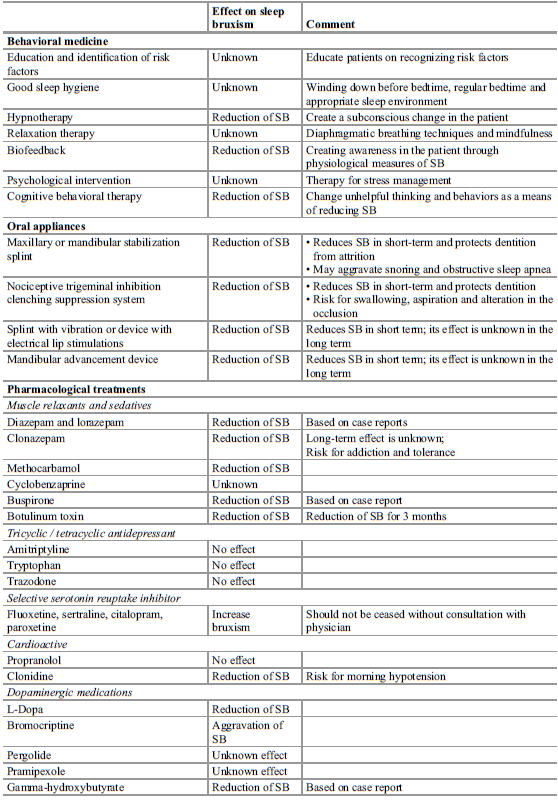
Image
From Contemporary oral medicine 2019 The management of SB aims mainly to reduce the damage and consequences of SB rather than reducing the muscle activity. Behavioural medicine: Most of these concepts are based on expert opinion and lack long term results. Avoidance of triggers such as cigarettes, caffeine, alcohol and illicit drugs can be beneficial. Habit awareness and reversal techniques for AB will reduce attrition of the dentition. Relaxation techniques, good sleep hygiene and hypnotherapy may be useful for SB and AB.  Oral appliance: First line therapy for SB associated with TMD. Mechanism of action is under unresolved debate. Current evidence suggests that oral appliances decrease SB transiently for the first 2 weeks of wear with SB continuing in the long term. Changes to occlusion may occur as a side effect and may not be tolerate by those with an active gag reflex. The use of maxillary stabilisation splints may increase the AHI and risk for snoring due to reduced to...

A post on bruxism (part 3)

From Contemporary oral medicine 2019 Signs of SB: -Tooth wear: Erosion most commonly causes excessive tooth wear with attrition following closely. Attrition can be charaterised by flat planes on teeth i.e wear facets, with planar enamel wear and shallow dentine wear with well defined margins in the enamel of incisal edges or with step like areas on the palatal aspects and equivalent facets on all opposing teeth. In contrast, erosion tends to damage dentine more deeply causing cupped lesions and loss of surface anatomy. Bed partner or parent reports of tooth grinding sounds can also be helpful in diagnosis. -Masseter hypertrophy: This is a benign, asymptomatic enlargement of one or both masseter muscles. There is a slight male predominance with an average age of 30 years. -Tongue indentation (Tongue scalloping): This has been associated with bruxism, more commonly clenching. It has been suggested that Tongue indentations may be caused by macroglossia secondary to systemic amyloid...

A post on bruxism (part 2)

From Contemporary oral medicine 2019 The etiology of SB is largely unknow but current theories hypothesise that SB is centrally mediated probably in the brainstem and has a multifactorial etiology. Sleep arousal is a brief awakening from sleep (3-15s) characterised by increased EEG, autonomic, cardiac and muscular activities without a complete return to consciousness. These normally occur <15 times an hour in response to external or internal stimuli. The association between sleep arousals and RMMA is well estabilished but they shouldn't be considered as the only cause or trigger of SB as they may be the window that allows RMMA during sleep. Additionally, arousals represent the end result of a multitude of physiological events involving the SNS, movement and respiration that may be more to blame. Genetics and familial predisposition: The level of evidence supporting a genetic predisposition to SB is low however there is a high proportion of SB subjects who have a family mem...

A post on bruxism (Part 1)

From Contemporary oral medicine 2019 Bruxism is a repetative jaw muscle activity characterised by clenching or grinding of the teeth and/or bracing or thrusting of the mandible. Sleep (SB) and awake (AB) bruxism are separate in their presentation and pathophysiology however they may overlap in some individuals. AB tends to occur in the form of clenching and bracing or thrusting of the mandible. Grinding can be seen but it is milder than that seen in SB unless the patient has a neurological condition. There seems to be a female predilicition with rations M:F between 2:3 and 1:3. AB is associated with stress, depression, addictions, neurological disorders such as Huntington's disease and congitive impairments such as in Rett's syndrome, Down syndrome and ASD. It is also significantly influenced by lifestyle. Management of AB is initially based of the recognition of awake clenching. This may involve lifestyle changes, habit reversal training, relaxation, hypnosis and biofeedba...

Dental sleep medicine series 7: The dental examination

Image
This post covers the physical and visual dental examination that can be done to screen for evidence of obstructive sleep apnoea. A thorough medical, dental and sleep history is necessary for a clear diagnostic direction. However, the clinical examination is invaluable to strengthen your diagnosis and to educate the behaviour on their risk factors and consequences of their diagnosis. The history and questionnaires will be covered in a separate post. Extraoral examination Blood Pressure measurement: High blood pressure is a common comorbidity in obstructive sleep apnoea. Screening patients for blood pressure is a good way to start the conversation leading to their diagnosis. Pulse oximeter reading: This measures the percentage of oxygenated hemoglobin in blood. This can indicate poor perfusion in an awake patient at rest. Ideal readings are above 95%. You would expect a person with poor perfusion to have comorbidities such as COPD, emphysema or a poor breathing pattern and ...

Dental sleep medicine series 6: Manifestations of sleep disorders

Image
Sleep is an important part of life; we spend around 1/3 of our lives sleeping. It is important for daily functioning, health and cognitive performance. Manifestations of poor sleep indicate the need for further investigation. Patients may not even be aware of their own problem as manifestations may initially seem to be unrelated to sleep. Clinicians must be vigilant in screening for the signs and questioning patients on the symptoms of sleep disorders to organise the appropriate investigations or referrals. Fundemental symptoms that prompt the need for further investigation include excessive daytime sleepiness, insomnia and unusual events at night. These From Sleep medicine 6th edition Insomnia Difficulty initiating or maintaining sleep combined with daytime sequelae. These may include excessive fatigue, impaired performance or emotional change. Insomnia has to be differentiated from normal variation in the need for sleep (5-9 hours) or the occasional difficult night which may be ...

Dental sleep medicine series 5: General examination of a patient with sleep disordered breathing

A general and medical examination of a patient suspected of having sleep disordered breathing is essential in diagnosis. History taking and bed partner questioning can often reveal the potential causes and differential diagnoses even before physical examination and special tests. The manifestations of sleep disordered breathing will be explored in future separate posts. The next post in the series will explore the specific dental signs when screening for obstructive sleep apnoea. Chief complaint Insomnia Often complain their nocturnal sleep is inadequate. Difficulty falling asleep, frequent awakening or early morning awakening with inability to fall asleep. Excessive daytime sleepiness Often complain of drowsiness that interferes with daytime activities and/or unavoidable napping. They may report that they need more sleep at night or there is drowsiness no matter how much sleep is had.They may report poor concentration or irritability. Children may exhibit hyperactivity rather t...

Dental sleep medicine series 4: Upper airway physiology

Sleep disordered breathing is a medical condition that requires a different approach in thinking than the dentistry that we are used to. A solid knowledge of airway anatomy and physiology is essential in understanding and treating OSA. From Sleep medicine 6th edition Numerous factors contribute to ventilation and mechanical properties of the thoracopulmonary system. Because sleep interacts with several of these factors, it has an impact on ventilation and gas exchanges through its effect on airway resistance, thoracopulmonary compliance, and lung volumes. As a consequence of its effect on upper airway muscle control and chest mechanics, sleep has a strong influence on upper airway stability. Accordingly, persons with compromised upper airway anatomy are at increased risk for development of obstructive sleep-induced disordered breathing, especially during the transition between wakefulness and sleep. Anatomy and physiology The upper airway includes the nasal cavity, pharynx and lary...

Dental sleep medicine series 3: Daytime sleepiness

Treating sleepiness is a big part of why we treat sleep. Many but not all patients with SDB will experience sleepiness. There is definite links to workplace and motor vehicle accidents which affect population morbidity and mortality. Often the patients who experience sleepiness are the quickest to accept treatment plans as they want to improve. Conversely, a person with chronic tiredness may be convinced that their condition is the norm and may be the ones who resist diagnoses and treatment the most. From Sleep medicine 6th edition Sleepiness is a problem reported by 10% to 25% of the population, depending on the definition of sleepiness used and the population sampled. It is most common in young adults and elderly persons. Sleepiness is a physiologic need state like hunger of thirst, with its intensity evident by how rapidly sleep onset occurs, how easily sleep is disrupted, and how long sleep endures. It is normally expressed in a 24 hour cycle related to the light-dark environme...

Dental sleep medicine series 2: What affects normal sleep

Sleep disordered breathing (SDB) is only a small fractions of defined sleep disorders. Many people in today's society are physiologically healthy but have factors such as medications, poor sleep hygiene and other lifestyle factors that can affect their sleep. Often we must rule out or treat SDB to realise an improvement in their condition but the optimisation of sleep quality and quantity only comes with treating the person as a whole and assessing the full range of factors that can affect sleep poorly. From Sleep medicine 6th edition Some generalisations about healthy adult sleep • Sleep is entered through NREM sleep. • NREM sleep and REM sleep alternate with a period near 90 minutes. • SWS predominates in the first third of the night and is linked to the initiation of sleep and the length of time awake (i.e., sleep homeostasis).   • REM sleep predominates in the last third of the night and is linked to the circadian rhythm of body temperature. • W...

Dental sleep medicine series 1: Normal sleep and sleep staging

Image
When treating sleep in a dental setting, it is useful to have a basic understanding of sleep and sleep staging to be able to interpret the results of a sleep study correctly and to be able to communicate effectively with medical colleagues. From Sleep Medicine 6th edition What is sleep Sleep is a reversible behavioral state of perceptual disengagement from and unresponsiveness to the environment. It is also true that sleep is a complex amalgam of physiologic and behavioral processes. Sleep is often associated with behavioural traits such as supine position, quiescence, closed eyes. Parasomnias can occur including sleep walking, sleep talking and tooth grinding. What are the stages of sleep? Two very separate stages of sleep have been identified: REM and Non REM sleep. NREM sleep is separated into 4 substages as defined by the EEG measurement axis (brain waves). NREM EEG is described as synchronous and have characteristics such as sleep spindles, K complexes, and high voltage sl...
Okay I think it's about time I start making a series of posts on dental sleep medicine. I have been doing Derek Mahony's mini residency for almost a year now and have learned a lot. What this series will cover: -Pathophysiology of OSA, snoring ,TMD and bruxism -The link between Bruxism, TMD and OSA -Parasomnias -Clinical examination -Sleep studies -Management strategies -Side effects of treatment and their management